
The Machine You Won’t Buy
You’ll sign for a new press without blinking.
It’s math. You run cycle time. Scrap. Labor. Payback. If the numbers work, the machine comes in, the floor gets rearranged, and everybody understands why. That’s how manufacturing thinks. Tangible in. Measurable out.
Then our marketing team walks into the meeting.
I’ve sat through enough of those meetings to recognize the shift. The air changes. Somebody says the product should sell itself. Somebody else says the sales team already “does that.” A third person mentions last year’s trade show and the banner that still lives in the trailer. The conversation ends the way it usually ends. “We’ll look at it when things slow down.”
What I’ve seen is that things rarely slow down in a useful way. They either stay busy enough to ignore the problem, or they get quiet enough that marketing can’t save the quarter.
That’s expensive math, and the sum is more than unrealized revenue. It equals lost production, market share left on the table, and growth that never starts.
The stories plants tell themselves.
Most manufacturers who skip marketing aren’t reckless. From my experience, they’re good, practical people using a different side of the brain. Unfortunately, those conversations lead to lopsided conclusions, like:
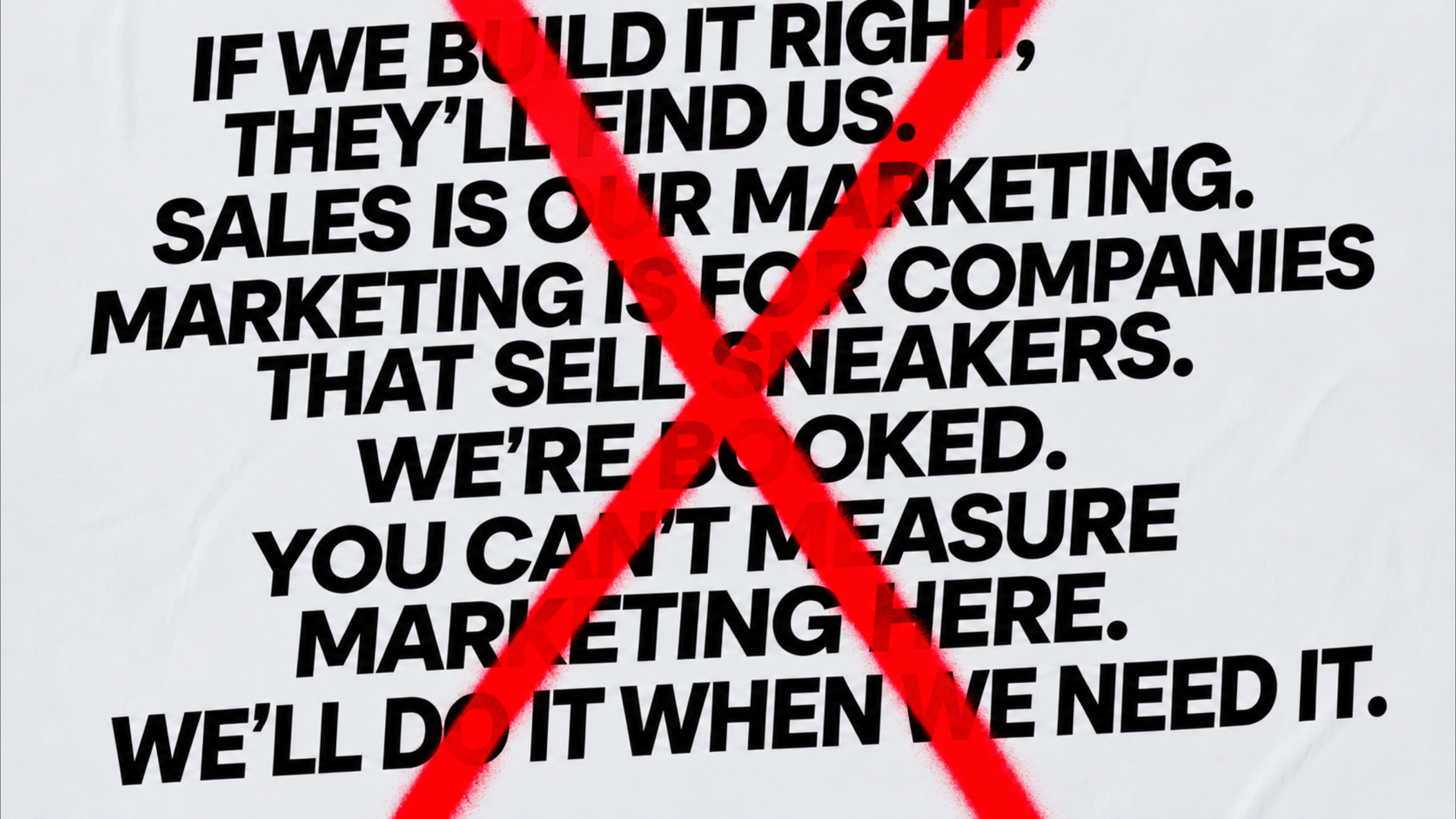
“If we build it right, they’ll find us.” Quality is not a search result. A buyer with a problem does not wander the industrial park until they bump into your best work. They search. They ask a peer. They look at a website at 9:40 p.m. after the kids are in bed. If you are not where they are when they are there, your quality is a secret you are keeping from the people who would pay for it.
“Sales is our marketing.” I’ve been told this more times than I can count. Listen, sales is expensive marketing done one conversation at a time. That used to be enough when the first serious contact happened early. It isn’t now. Buyers do most of their homework before they ever pick up the phone. By the time your salesperson gets in the room, the shortlist is often already written. If your company never showed up in that research, the best closer in the world is still walking into a conversation that started without them.
“Marketing is for companies that sell sneakers.” Industrial buyers are not robots with purchase orders. They are people who do not want to get fired for picking the wrong supplier. Specs matter. So does confidence. So does whether you look like a going concern or a shop that last updated its site during the Obama years. Brand is not a logo. It’s a perception. It’s the shortcut a plant manager uses when the committee asks, “Have we heard of these people?”
“We’re booked.” Good. Booked is not a strategy. Booked is a weather report. In my 40 years, I’ve seen it all. The accounts that keep you booked get acquired, merged, miss a forecast, or bring the work back in-house. The plants that treat full capacity as a reason to unplug marketing are the ones who later ask why the phone got quiet all at once.
“You can’t measure marketing here.” You measure everything else that costs money. Marketing is not magic. It is either putting you on the shortlist, or it isn’t. It is either shortening the time from first look to first conversation, or it isn’t. It is either helping you win on more than price, or it isn’t. If nobody is tracking that, the problem isn’t measurement. It’s management.
“We’ll do it when we need it.” By then the buyer already has a favorite. You just haven’t met the buyer yet.
The deal doesn’t wait for you.
Here is the part most manufacturers still have not absorbed. If they have, they’ve chosen to accept the impending folly.
A lot of the buying happens before anyone at your company knows a deal exists. Gartner, the research firm that studies how businesses buy, has been blunt about it for years: when a B2B group is considering a purchase, they spend only about 17% of that time meeting with all potential suppliers combined. Split that across three vendors, and your best closer likely gets only a silver for the effort. The rest of the decision-making process is their own research, internal debate, peer conversations, and whatever they can find about you online at two in the morning.
6sense, a firm that researches B2B buying behavior, makes the next part uncomfortable. Their studies show that by the time that prospect reaches out, they usually already have a preferred vendor. That favorite wins most of the time. They are not calling to discover you. They are calling to confirm what they think they already know. You are not it. But they require at least three bids.
That is the real issue beneath the usual debate about whether marketing is worth the investment. Not how many leads came in. Not whether the logo looks current. Not whether anybody is liking your LinkedIn posts. The issue is whether you show up in the hours when the buyer is researching and whether you’ve built a brand worth trusting before he decides.
What marketing is on a plant floor.
Marketing, done honestly, is not a commercial with dramatic sparks and a voiceover about excellence. It’s probably not a commercial at all.
It is the system that answers the questions a buyer asks before they trust you enough to talk to your salesperson.
Can you hold the tolerance? Have you done this kind of work before? Will you still be here in five years? Do you understand my industry, or do you make precision components for a wide range of applications? What happens when something goes wrong?
If your website, your content, your reputation, and your proof can’t answer those questions, your salesperson struggles to convince a skeptical stranger. Conversely, if they can answer those questions before the sales call, your salesperson inherits a conversation that already has a pulse. One burns time. The other actually moves the pendulum.
Think of it the way you already think about the floor. A machine that sits idle is not “saving money.” It is a fixed cost waiting for work. Likewise, a sales team chasing cold calls while your prospects research without finding you is the same thing.
The ROI a plant can actually feel.
You already own capacity. Labor. Equipment. Overhead. The expensive part of manufacturing is not finding a brochure vendor. It is paying for output that is not fully used, or winning work only when you are the cheapest name on a bid list.
What I’ve seen work is marketing that earns its keep in a handful of places a controller can respect.
You get in the room earlier. If buyers form a shortlist before they call, the return is simple: be on it. One incremental job that fits your sweet spot will often cover a year of serious marketing. Not a spray of junk leads. One right job!
Your salespeople stop spinning. When a prospect arrives already knowing what you do, who you serve, and why you are not a coin toss, the first meeting is about fit instead of introductions. Shorter sales cycles. Fewer quotes that were never going to close. More time on accounts that can actually buy.
You stop competing like a commodity. The vendor nobody knows has one move left: price. The vendor the engineer has already seen solve a problem like theirs can defend margin. That difference does not show up as “impressions.” It shows up on the invoice.
The next hire gets easier. Plants that look invisible to customers look invisible to talent too. The same story that helps a buyer trust you helps a machinist, an engineer, or a plant supervisor decide you are not a last resort. In a tight labor market, that is not branding. That is staffing.
Do the ugly math. Take your average profitable job. Take what one salesperson costs you for a year, fully loaded. Then add the hours they spend re-explaining things a clear website, case study, and basic credibility should have already handled before the call.
That cost is real. It just never gets its own line on the P&L, so it feels pain-free.
Now ask a better question than “What do we get from marketing?” Ask, “What does it cost us to keep sending salespeople into deals that started without us?”
Buy the machine.
You do not buy a press because you love presses. You buy it because two things cost you money: orders you can’t fill, and machines sitting quiet. The press turns open demand into work for the capacity you already own.
Marketing is the machine that feeds the machines.
It does not replace the salespeople who know how to walk a plant and tell the truth. It does not turn a sloppy shop into a trusted supplier. It takes what you already built and makes sure the people who need it can find it, believe it, and put you on the list before the other favorite is chosen.
From my experience, the manufacturers who keep waiting for marketing to feel as solid as a piece of equipment are waiting for the wrong sensation. Trust never arrives on a flatbed.
The deal is already starting.
The only question is whether you are in it.